
Working with Resipoint: 2. Design and specification

In high-rise residential construction, M&E challenges don’t always start onsite. Often, they creep in much earlier, during the design phase.

Tight utility cupboard spaces, intricate piping and wiring, long-term maintenance access… When these and other project requirements aren’t factored in early, complexity quickly escalates during installation, increasing the risk of delays and rework.

That’s why design is one of the most important stages of working with Resipoint: it’s the careful planning that leads to perfect execution.

What happens during the design stage?

We remain in close contact with your team, ensuring every technical requirement uncovered during our initial consultation is carefully coordinated before manufacturing begins.

Through regular Design Team Meetings (DTM), we collaboratively review layouts, equipment selection, service routes, and integration challenges as the design evolves.

To ensure complete clarity and accountability, all project requirements are captured and tracked through a detailed RFI process, helping ensure that every point is reviewed and resolved before sign-off.

1. Adapting to complex apartment layout

Modern residential developments rarely consist of one apartment type repeated hundreds of times: most schemes involve numerous layouts and spatial differences. Without expert planning, this will require an overwhelming number of unique utility room configurations.

At Resipoint, the design process focuses on simplifying this complexity wherever possible.

Starting from standardised design principles and a library of hundreds of detailed utility room drawings developed across previous projects, we work closely with your team to reduce unnecessary variation.

This often means reducing dozens of apartment layouts into a small number of repeatable utility room types.


“People often assume standardised designs are rigid, but they are actually highly adaptable. In reality, the only thing the resident sees is the doorway, the physical shape of the space behind it can vary significantly. This allows us to suit our configurations to almost any apartment design – as long as the utility room fits the footprint, we can adapt the internal layout to suit the project’s specific needs.”

Frazer Ross, Resipoint Technical Manager


2. Solving spatial constraints through coordination

Utility rooms are becoming increasingly complex. Within a very limited footprint, they must often accommodate heating systems, ventilation, electrical distribution, telecoms, metering, and other essential services.

New regulations are also complicating this challenge. The Building Regulations Part O, for instance, tends to dictate much larger MVHR equipment compared to just a few years ago.

Our design process addresses these issues before manufacturing begins. During the specification stage, our team carefully coordinates:

  • Electrical interfaces
  • Service zones
  • Manufacturer clearance requirements
  • Access panels and maintenance zones
  • Connection points for onsite integration

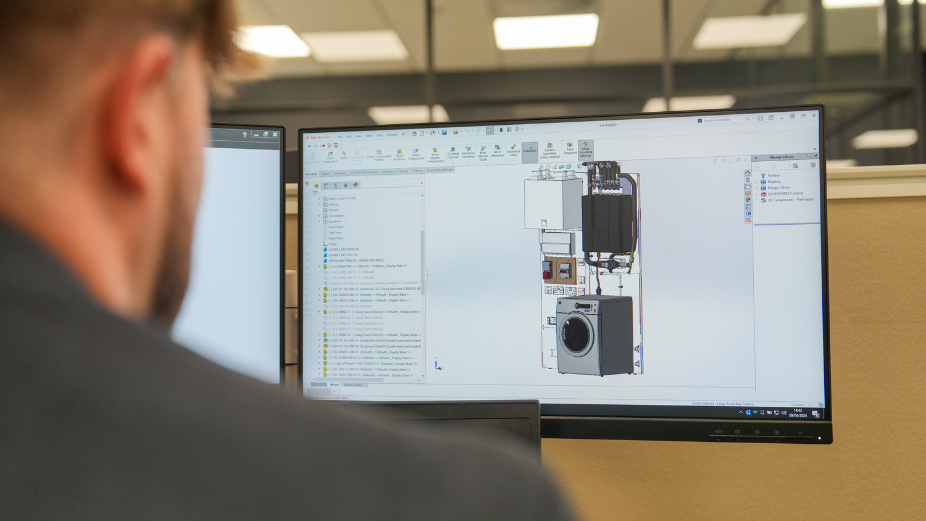
Using 3D CAD modelling and technical coordination throughout the DTM process, we identify potential clashes early and resolve them before they become costly onsite problems.

3. Designing compliance into your project

Compliance is another critical part of the design and specification phase. Modern utility rooms must satisfy a wide range of regulations, standards, and manufacturer requirements. These can include:

    • Part M accessibility requirements
    • G3 hot water safety regulations
    • Manufacturer servicing clearances
    • Electrical safety standards
    • Fire stopping considerations
    • Future maintenance access

If these requirements are treated as an afterthought, they may lead to delays and redesigns later in the programme.

Resipoint instead brings compliance into the design process from the start. This helps ensure that every utility room can be built to your exact specification and that it is also practical to install and maintain throughout the building’s lifecycle.


“Compliance regulations are central to the design because they often fix equipment into a specific position. There can be specific regulatory heights for consumer units, isolation valves, and meter boards. Our trick is to plot those ‘unmovable’ items first to ensure the layout is fully compliant with Part G3 or CDM regulations, and then we fit the rest of the kit around them in a way that ensures everything remains accessible for future maintenance.”

Frazer Ross, Technical Manager at Resipoint


4. Creating clarity before manufacturing begins

One of the biggest advantages of offsite manufacture is programme certainty, but this certainty only comes from clear design coordination.

Before production begins, we’ll deliver to you complete M&E schematics and General Arrangement drawings, where every aspect of the utility room is signed off collaboratively with your team.

These schematics will clearly define:

      • Layouts
      • Equipment specifications
      • Pipework routing
      • Electrical interfaces
      • Access requirements
      • Service zones
      • Finishes and configurations

Through this process, we cut uncertainty during later stages of the programme, reducing the risk of last-minute changes, trade clashes onsite, and inconsistent apartment quality.

We can also bring earlier certainty on long lead times, ensuring sufficient time to organise the supply chain and meet critical programme deadlines.


Ready to design M&E complexity out of your project?

Let’s talk


What’s next?

In our next blog, we explore Step 3: Benchmark review and sign-off. Before full production begins, you’ll review a “golden unit” built to the agreed specification, which will become the benchmark throughout the whole production process. This helps ensure you’re completely satisfied with the layout, quality, and service integration of our units.

Initial consultation

Working with Resipoint: 1. Initial consultation

Project delays, late reworks, compliance risks, spatial constraints… installing M&E services in high-rise buildings, across multiple apartment layouts, is never a simple task. In fact, it often turns out to be one of the most complex parts of the development.

At Resipoint, we engineer offsite utility room solutions to make the complex simple and predictable while also ensuring the quality of your M&E installations.

It’s a collaborative effort where your vision and our expertise align to solve unique project challenges and lead to repeatable success. Our Working with Resipoint blog series will help you navigate this six-step process:

  1. Initial consultation
  2. Design and specification
  3. Benchmark review and sign-off
  4. Manufacturing and quality testing
  5. Delivery to site
  6. Handover and ongoing support

In this first blog, we explore the initial consultation – the crucial stage after you place an order, where we get to know your project, identify possible issues, and lay the groundwork for a smooth M&E delivery.

Every project starts with a conversation

The initial consultation is more than just a meeting, it’s the foundation of every successful Resipoint project. During this stage, our team works closely with clients to understand the full context of the development, including spatial constraints, services strategy, and technical requirements.

Whether your project is at concept stage or well into technical design, our goal is to recognise potential challenges before they reach the site. By doing so, we engineer solutions that prevent delays, reduce risk, and maintain consistent M&E quality at scale.

What happens in a consultation?

During the consultation, we cover key areas such as:

  • Spatial constraints and compliance requirements: we review utility cupboard dimensions, access zones, and regulatory obligations – including Part M accessibility as well as CDM and ongoing maintenance requirements. Identifying constraints and ad hoc requirements early allows us to design units that fit precisely within each apartment.
  • M&E systems integration: from heating and ventilation systems to metering, electrical, and telecoms, we consider how every service connects seamlessly within the prefabricated unit.
  • Programme and sequencing considerations: to ensure the success of our utility rooms and their integration in your project, we discuss installation timing, site access, and coordination with multiple trades to streamline onsite processes.
  • Standardised vs bespoke configuration needs: we start from proven, standardised designs that can be adapted to suit multiple layouts, ensuring efficiency without compromising on compliance or performance.


“With every project, the devil is in the detail. There are so many small, seemingly minor, points of consideration in Utility Rooms which can make or break the whole design.  Resipoint has masses of experience to draw out these issues and design them out before they become a costly problem.”

Frazer Ross, Resipoint Technical Manager


Is this right for me?

We often hear preliminary questions about timing, delivery and general integration issues at this stage. Let’s address some common concerns.

When’s the best time to procure utility cupboards?

Typically at RIBA Stage 4, but design discussions should start as early as Stage 2 – particularly for HRB (Higher-Risk Building) projects – to simplify the submission of documents to the Building Safety Regulator.

Will prefabrication fit my existing design?

Our expert Preconstruction Team can adapt a small number of standardised designs to fit even complex layouts, so redesign is not needed. By tailoring our units to your unique situation, we make offsite construction viable even in complex, multi-layout developments.

What if there are site access constraints for delivery?

We plan logistics early, ensuring units can be safely moved via hoist or lifting cage and positioned on site with minimal disruption – delivery is scheduled to align with your programme.

Are prefabricated units harder to maintain long-term?

Not at all. Every unit is designed with service access in mind, and comes with full operation and maintenance documentation. Clear equipment responsibility matrices ensure facilities management can maintain systems efficiently.

What if our project has a tight programme?

Offsite manufacture runs in parallel with onsite works, reducing labour requirements and sequencing conflicts. Units arrive ready to install, ensuring predictable, snag-free delivery that keeps your programme on track.

How do we know quality will be consistent across hundreds of units?

Every unit is built in a controlled factory environment combining precise CNC machining and manufacturing expertise, including multi-stage quality checks and full testing before dispatch. This way, we deliver repeatable precision and consistent performance across all apartments.

Got more questions for us? Don’t hesitate to reach out, or speak to one of our experts by calling 01452 226022 – we’re always happy to hear about your project.

Why consultation matters

The initial consultation sets the tone for the entire project. By addressing design, spatial, and programme challenges early, Resipoint helps clients achieve:

  • Snag-free, predictable M&E delivery
  • Cost certainty and reduced risk
  • Seamless integration with the building’s architecture
  • Reduced onsite labour and coordination headaches

This stage ensures every decision from design to handover is informed, practical, and aligned with project objectives.


Discover more about how we can support your project?

Enquire NOW


What’s next?

In our next blog, we’ll talk about Step 2: Design and specification and show how consultation insights are translated into fully coordinated, project-ready utility room designs – ready for benchmark review and manufacture.

Constructionline logo